
Physical Agent Operation System (PhyAgentOS)
https://github.com/SYSU-HCP-EAI/PhyAgentOS
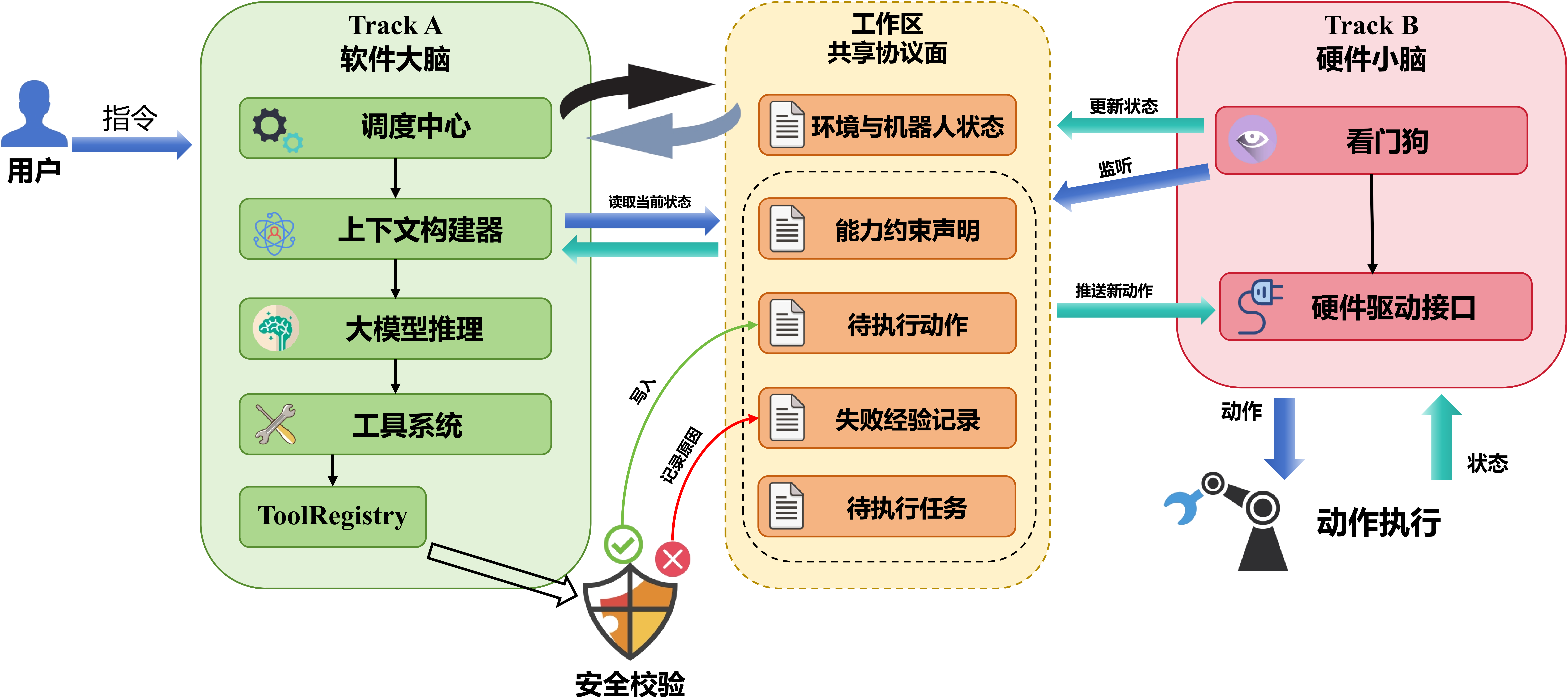
Physical Agent Operation System (PhyAgentOS) is a self-evolving embodied AI framework based on Agentic workflows. Moving away from the "black-box" model of traditional "large models directly controlling hardware," PhyAgentOS pioneers a "Cognitive-Physical Decoupling" architectural paradigm. By constructing a Language-Action Interface, it completely decouples action representation from embodiment morphology, enabling standardized mapping from high-reasoning cloud models to edge physical execution layers.
PhyAgentOS utilizes a "State-as-a-File" protocol matrix, natively supporting zero-code migration across hardware platforms, sandbox-driven tool self-generation, and safety correction mechanisms based on Multi-Agent Critic verification.
Framework
PhyAgentOS's core is a local workspace where software and hardware operate as independent daemons reading/writing files:
- 📝 State-as-a-File: Software and hardware communicate by reading/writing local Markdown files (e.g.,
ENVIRONMENT.md,ACTION.md), ensuring complete decoupling and extreme transparency. - 🧠 Dual-Track Multi-Agent System:
- Track A (Cognitive Core): Includes Planner and Critic mechanisms. Large models do not issue commands directly; they must be verified by the Critic against the current robot's runtime
EMBODIED.md(copied from profiles) before being committed. - Track B (Physical Execution): An independent hardware watchdog (
hal_watchdog.py) monitors and executes commands. Supports both single-instance mode and Fleet mode for multi-robot coordination.
- Track A (Cognitive Core): Includes Planner and Critic mechanisms. Large models do not issue commands directly; they must be verified by the Critic against the current robot's runtime
- 🔌 Dynamic Plugin Mechanism: Supports dynamic loading of external hardware drivers via
hal/drivers/, allowing for new hardware support without modifying core code. - 🛡️ Safety Correction Mechanism: Strict action verification and
LESSONS.mdexperience library prevent Agent workflows from going out of control. - 🎮 Simulation Loop: Built-in lightweight simulation support allows verification of the full chain from natural language instructions to physical state changes without real hardware.
- 🗺️ Semantic Navigation & Perception: Built-in
SemanticNavigationToolandPerceptionServicesupport resolving high-level semantic goals into physical coordinates and constructing scene graphs by fusing geometric and semantic information.
- hcp@sysu.edu.cn
- 广州市广州大学城外环东路132号

- Projects
- Computer Vision
- Multimodal
- Robotics
- Links
- Git-Lab